Merge PDF files in a predictable order
Combine two or more PDFs into one visual reading copy. Converttwo uses natural filename order, retains each file's internal page order, and downloads the result as merged.pdf.
Combine your PDFs
Use numbered filenames when order matters, then inspect the rebuilt result before sharing it.
Open the Merge PDF toolHow to merge PDF files
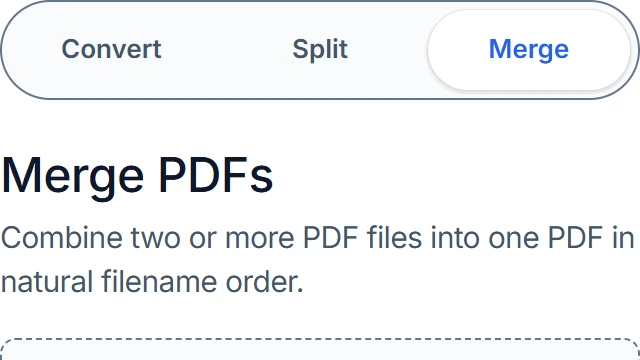
Prepare filenames
Add prefixes such as 01, 02, and 03 so natural filename order matches the intended sequence.
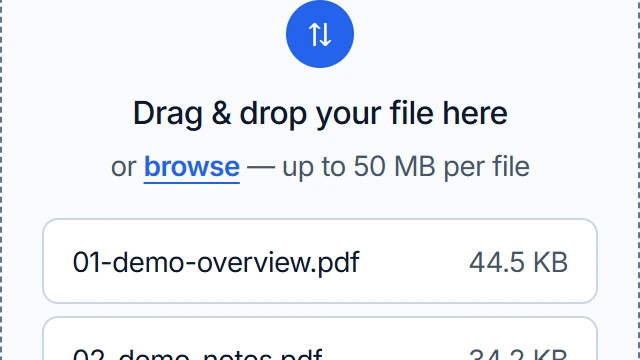
Select and verify
Choose at least two PDFs, no more than 50 MiB each, and check the displayed list.
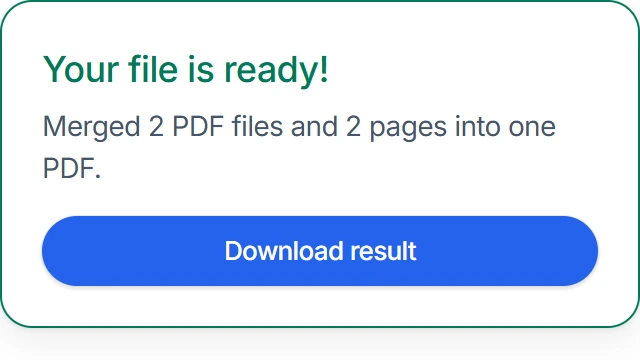
Convert and review
Download
merged.pdf, then verify page count, order, dimensions, and visible quality.
What goes into the merged file
The tool accepts at least two PDFs. Files are sorted by natural filename order, so file-2.pdf comes before file-10.pdf. Pages within each source keep their internal order. The interface does not provide drag-to-reorder controls, so rename files before selection and confirm the list before converting.
The single output is named merged.pdf. Mixed portrait, landscape, Letter, A4, and custom page dimensions can remain visibly different because each rendered page is inserted with dimensions based on its source page. Check print preview if a printer will force all pages onto one paper size.
Rendered quality and PDF structure
Merge does not copy source PDF objects into a new container. PDF.js renders each page at scale 2 onto a white canvas. For an ordinary PDF whose base coordinates correspond to 72 points per inch, that is nominally about 144 pixels per inch. The canvas is encoded as JPEG at quality 0.92 and placed inside a new PDF page.
This preserves a visual representation, not the original structure. Searchable text, vectors, interactive links, forms, bookmarks, layers, embedded files, accessibility tags, and source metadata are lost. Annotation appearances may remain visible as pixels, but annotation objects and behavior do not. A digital signature becomes invalid because the signed document has been rebuilt. Keep every source PDF, especially signed originals.
Transparent page regions are flattened onto white. Fine text, line art, barcodes, and already-compressed scans can show raster or JPEG artifacts. Zoom to 100% and test critical marks rather than relying on thumbnails.
Inputs, practical limits, and privacy
Each selected file may be up to 50 MiB. That upload-style limit does not guarantee every permitted PDF will finish: every page must be decoded, painted to a canvas, encoded, and held while the new document is assembled. Long PDFs, high-resolution scans, unusually large page dimensions, and complex graphics can exceed available browser memory or canvas limits.
PDF processing occurs in the browser and selected PDF content is not sent to the document-conversion API. The web page still requests third-party assets, including scripts and fonts, so this is browser processing rather than a fully offline application. Review the Privacy Policy before working with confidential or regulated records.
There is no password-entry workflow. A password-protected or encrypted PDF may fail to open; remove protection only when authorized and use an appropriate PDF application.
When merge is unsuitable
- Use a structure-preserving PDF editor when selectable text, vectors, links, forms, bookmarks, tags, comments, attachments, or metadata must survive.
- Use a signature-aware packaging workflow when digital signature validity or legal verification matters.
- Use a print-production tool when color management, prepress checks, exact object preservation, or press-ready output is required.
- Reduce or batch very long, scan-heavy documents when browser memory is likely to be a constraint.
Existing tested evidence · September 9, 2026
Inspect a six-page merge result
The existing PDF tools test started with a 13.0 KB searchable six-page PDF, split it into six numbered files, and selected those files in page-number order for merging. The result was a 1.48 MB, six-page merged.pdf. Visible pages and order remained, while text extraction found no text in the merged output. This is one controlled example, not a promise about every PDF.
Repeat the check
- Open both files in the same PDF viewer.
- Compare page count, page order, orientation, and visible dimensions.
- Search for a sentence in each file and inspect small text at 100% zoom.
- Check links, forms, annotations, and signature status if those features matter to your workflow.
Troubleshooting a merge
The PDFs appear in the wrong order
Rename them with zero-padded numeric prefixes such as 01-cover.pdf, 02-report.pdf, and 03-appendix.pdf, then select them again. The tool follows natural filename order rather than selection order.
The browser slows down or stops
Close other memory-heavy tabs and merge fewer or shorter files at a time. A small compressed file can expand to large canvases while rendering, so file size alone does not predict memory demand.
Text cannot be selected after merging
That is expected for this image-based rebuild. Use a PDF application that preserves source objects if searchability or accessibility is required.
A protected PDF will not open
The converter has no password prompt. If you are authorized, create an unlocked copy in suitable PDF software before merging; otherwise do not bypass the protection.
Merge PDF FAQ
How many files are required?
At least two PDFs are required, and each may be up to 50 MiB. Available memory can impose a lower practical limit for page-heavy or high-resolution files.
What is the download called?
The combined document downloads as merged.pdf.
Will comments or signatures survive?
Visible annotation appearances may be painted into page pixels, but annotation objects do not survive. Rebuilding also invalidates digital signatures.
Ready to assemble a visual reading copy?
Order the filenames first, retain the originals, and review the completed PDF at full size.
Merge PDF files